

Ever wondered why 1 in 4 Victorian learner drivers fail their VicRoads test despite Australia’s highest pass rate of 75%? It’s not luck. Assessors score critical errors, head checks, intersections, speed zones, and maneuvers like reverse parallels using a strict checklist.
This guide reveals exactly what they watch for, common pitfalls, pro tips, and insider routes to pass for the first time.
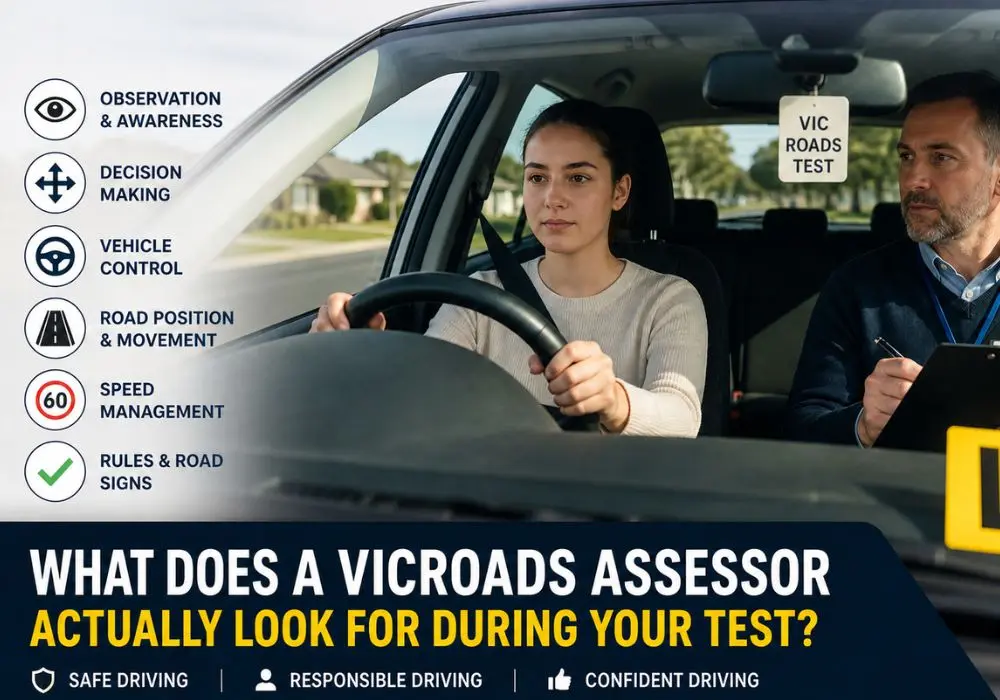
What the Scoring Sheet Actually Measures
The assessor uses a structured form that splits your performance into two categories:
- Critical errors
- Minor errors
A critical error does not end your test immediately, but if you accumulate more than one in Stage 1 or more than two overall and your test is done. An Immediate Termination Error (ITE), such as speeding or running a red light, ends it on the spot, regardless of how well you drove before it.
| Error Type | What It Means | Outcome |
| Critical error | Poor judgement, unsafe or illegal action | Fail if 2+ total or 1+ in Stage 1 |
| Immediate Termination Error | Dangerous or illegal action with no room for doubt | Instant fail |
| Minor error | Small deviations from correct technique | Accumulate into a fail |
Victoria has the highest driving test pass rate in Australia at around 75%, well above the national average of 62%. That still means roughly one in four people fail the first time, usually for the same recurring reasons. You have to read the VicRoads Drive Test Criteria booklet before your test. It is publicly available and spells out exactly what assessors record for every task. Most learners skip it entirely.
Head Checks is The Single Biggest Reason People Fail
A driver with six years of overseas experience shared their story on an Australian motoring forum. They failed their Victorian driving test for two reasons: incorrect hand position and not exaggerating their head checks enough.
They were doing head checks. The assessor simply could not see them clearly.
The assessor is watching your head move, not just watching the car move safely. If your head does not turn visibly before a lane change, a merge, moving off the kerb, or reversing, that is an error regardless of whether the manoeuvre was safe.
| Our Tip: Turn your head deliberately and fully toward the blind spot. It feels unnatural, but it is unmistakable to the assessor sitting beside you. A slight tilt or a quick glance does not register the same way. |
Intersections: The Sequence of Checks Matters
Failing at an intersection is rarely about not giving way. It usually comes down to what you do as you approach.
The assessor expects you to slow down early, check left, right, then left again, make a clear decision, and move through confidently. Creeping forward at a T-intersection looks like hesitation and is marked as poor decision-making.
The order of your checks also matters. Assessors look for the correct sequence of mirror check, head check, and indicator. Even if you do everything, doing it in the wrong order can cost you marks.
A common mistake across Victoria, following the car in front through a stop sign. The car ahead may have already crossed the line, but you still need to stop. Many drivers miss the sign and just follow traffic instead of reading the road themselves.
| Our Tip: We recommend treating every stop sign as if it is invisible until you are physically at the line. Do not follow the vehicle in front. Stop fully with wheels stationary, then look and go. A rolling stop, even a slow one, is a critical error. |
Speed Management: School Zones Will End Your Test on the Spot
Driving at the speed limit is not the hard part. Knowing when the limit changes is.
In Victoria, school zones drop to 40 km/h on school days from 8:00 am to 9:30 am and again from 2:30 pm to 4:00 pm. This applies in places like Melbourne, Geelong, and Ballarat. If you miss the time change, you risk failing fast.
One driver shared a case on an Australian motoring forum. They were doing 55 km/h at 3:02 pm. The school zone had just started. The test ended within minutes.
Any speed over the posted limit counts as an instant fail. Even 42 km/h in a school zone is enough to end the test.
| Our Tip: We suggest reducing your speed before you reach the school zone sign, not as you pass it. If you are unsure whether the zone is active, slow down anyway. The cost of unnecessary caution is zero. The cost of getting it wrong is your entire test. |
Three-Point Turns and Reverse Parallel Parking
These set-piece manoeuvres don’t appear on every test, but when they do, they trip people up for the same reasons.
Three-point turn
The assessor cares less about how many points it takes and more about whether you:
- Check for traffic and pedestrians before each movement
- Control the vehicle smoothly without mounting the kerb
- Position correctly to continue in the intended direction
In Victoria, there’s no formal rule that says it must be done in three moves. Taking four is fine if everything else is correct. Mounting the kerb is a critical error.
Reverse parallel park
Head checks are non-negotiable here too, before reversing, before opening out, before completing the park.
The finished position should be within 30 centimetres of the kerb, roughly parallel, and within a reasonable distance of the space you started in. Getting within that 30 cm range while keeping the car smooth and controlled is what passes.
What Assessors Notice
Beyond the formal checklist, there are a few things assessors observe that candidates rarely think about.
- Smoothness of inputs. Jerky braking, sharp steering corrections, and lurching acceleration all tell the assessor that you’re reacting rather than anticipating. Smooth inputs suggest you’re reading the road well in advance.
- Communication with other road users matters too. Use your indicators early, not just as you begin to turn. Making eye contact or giving a wave when merging. These are not formally scored as separate items, but they form part of how assessors assess your situational awareness.
- Behaviour at roundabouts. This is especially relevant in suburban Melbourne, where roundabouts are everywhere. Assessors look for correct lane use, appropriate approach speed, giving way to vehicles already in the roundabout, and indicating on exit. Failing to indicate on exit is a minor error but a consistent one.
- Your response to unexpected situations. A pedestrian stepping off the kerb. A cyclist moving into your path. The assessor wants to see calm, appropriate action, not panic, not overcorrection.
The Test Route Is Not Random
VicRoads test routes are standardised within each testing centre. Frankston, Ringwood, Pakenham, Dromana, Mitcham, Thomastown, and Geelong each use their own fixed roads.
This is not confidential. Practise specifically on the roads near your centre and you will already know where the school zones sit, which roundabouts appear, and where speed limits change.
Rebook after a fail and the appointment fee is waived, but the test fee applies again.
Get out on those roads in the week before your test. Not to memorise a route, but to feel settled in that specific environment when it matters.
Confirm you have passed the Hazard Perception Test (HPT) before booking your drive test. It is a mandatory prerequisite. Check the current fee and booking process on the official VicRoads website.
Frequently Asked Questions
Can I use my own car for the VicRoads driving test?
Yes, but it must be registered, roadworthy, and meet VicRoads vehicle requirements. One trap many learners miss: cars with an electronic or foot-operated park brake cannot be used, because the assessor needs access to a traditional handbrake lever from the passenger seat.
What happens if I stall during the test?
Stalling is recorded as a critical error, but it does not automatically end your test unless it disrupts traffic or creates a dangerous situation. Recover calmly, restart the engine, and continue without making it a bigger moment than it needs to be.
How long do I have to wait to rebook if I fail?
After a first fail you can rebook immediately, but after a second fail you must wait at least 8 days before your next attempt. Fail a third time and the wait extends to 29 days, so it is worth taking that time to genuinely address what went wrong before going back.