

Most learners spend months preparing for their driving test and forget to check the one thing that can cancel it before it even starts, the car itself.
Every examiner in Australia is required to inspect your vehicle before you drive a single metre. Fail that check, and your test is cancelled, your booking fee is gone, and you’re back in the queue.
Here’s exactly what gets checked and what to do about it.
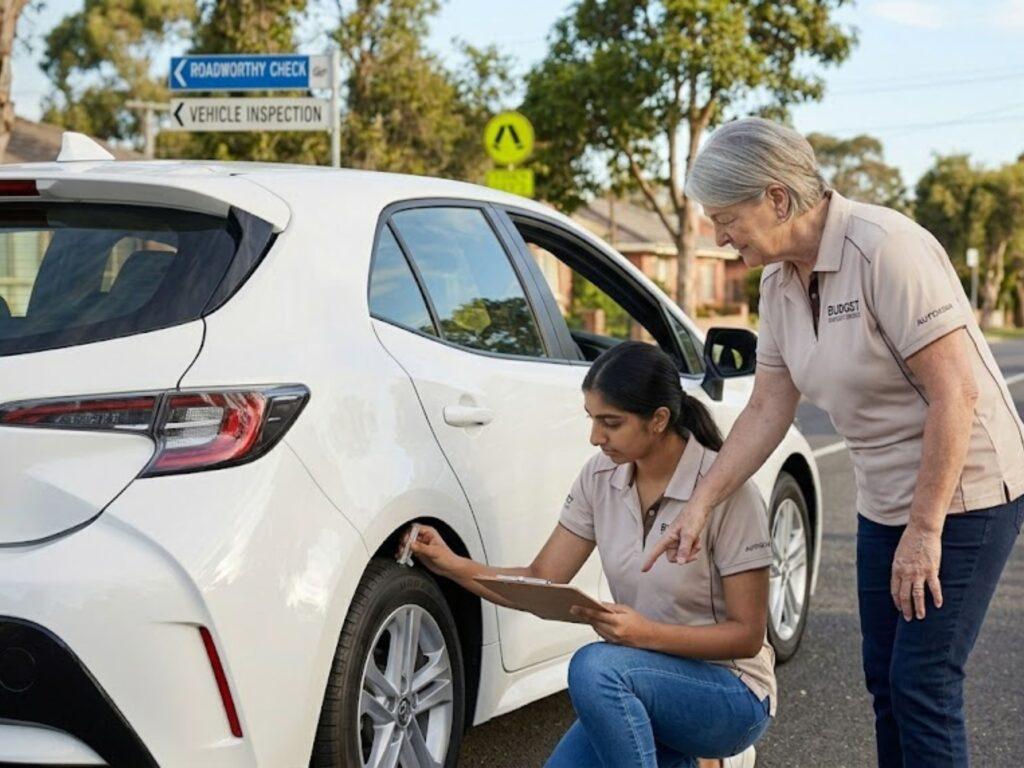
What the Examiner Is Actually Checking Before You Drive
Every state authority in Australia, whether that’s Transport for NSW, VicRoads, or TMR in Queensland, requires the examiner to inspect the vehicle before the test begins. If the car doesn’t pass, the test is cancelled, and your booking fee is not refunded.
The examiner is sitting in that car with you for the next 30 minutes. They have a legal obligation to make sure the vehicle meets minimum safety standards before they get in.
| Our Tip: We always recommend arriving at the test centre 10 to 15 minutes early, specifically to allow time for the vehicle check. If there’s a minor issue that can be fixed on the spot, like adjusting mirrors or removing L plates, having a few extra minutes gives you a chance to sort it without panicking. |
The Checks That Actually Get Tests Cancelled
Lights and Indicators
Every light needs to work. Headlights, brake lights, reverse lights, number plate light, and all four indicators. Examiners will typically ask you to operate them before the car moves.
A single blown globe is enough to fail the check, and a replacement globe from an auto parts store is only a few dollars. Check every light the night before your test, not the morning of your appointment.
Tyres
Tyres must have at least 1.5mm tread depth across the entire width, and must not be mismatched, worn, or damaged.
A quick way to check:
Grab an Australian 20-cent coin with the platypus facing down and insert it into the tread groove. If you can see the platypus’s beak, you’re borderline and should get the tyres checked by a mechanic.
One thing that catches people off guard in Queensland: spare tyres cannot be used for a driving test, as they are designed for emergency use only.
If you’ve been running on a spare, sort a proper tyre before test day.
| Our Tip: We see tyre issues come up regularly. Tread depth is one thing, but mismatched tyre construction is another. All four tyres should be the same construction type, either radial or cross-ply. If you’re unsure, your mechanic can confirm this in five minutes during a regular service check. |
Windscreen
The windscreen must not have chips or cracks in the driver’s direct line of sight. Acceptable limits vary by crack type: hairline cracks up to 30mm, edge cracks up to 75mm, and bullseye chips up to 16mm. Anything in the driver’s direct sightline is unacceptable, regardless of size.
Seatbelts
The examiner will be wearing one. Seatbelts must be operational and must not be frayed, twisted, or damaged.
Test the driver’s belt and the front passenger belt. If either one doesn’t buckle cleanly, jams, or won’t retract, the test won’t go ahead.
Dashboard Warning Lights
This one surprises people. The dashboard must be free of any active warning lights. Engine warnings, ABS lights, and airbag warnings are all grounds for cancellation, as they indicate a potential safety issue.
If your car has a persistent warning light you’ve been ignoring, get it looked at before your test date.
Our Tip: We always tell learners to check the dashboard as part of their pre-drive routine. If a warning light you’ve never seen before shows up on test morning, don’t attend the test. Call the centre to explain and ask about rescheduling.
The Takata Airbag Issue
Personally imported vehicles with airbags fitted cannot be used for a practical driving test due to the Takata Airbag Recall, as there is no way to verify whether the airbags in a personally imported vehicle are faulty.
The Takata airbag recall is the most significant compulsory recall in Australia’s history, involving more than 3 million vehicles. Affected brands include Honda, Toyota, Mazda, Mitsubishi, Nissan, Subaru, Ford, and many others.
State-Specific Rules Worth Knowing
In Australia, each state sets its own requirements, and some are stricter than others on specific items.
New South Wales: The vehicle must be currently registered. An expired rego, even by one day, means the test cannot proceed.
Victoria: The vehicle must meet handbrake requirements, specifically a manual pull-up handbrake that is centrally mounted and accessible from the passenger seat, unless the vehicle has dual controls. A loose or barely functional handbrake will end your test.
Queensland: The examiner will inspect the vehicle before the test to confirm it meets requirements. If it doesn’t pass, you won’t be able to take the test and will lose your booking fee. TMR also requires that driver assist features such as GPS, speed alerts, and park assist be switched off for the duration of the test.
Western Australia: L plates must be removed before the practical driving assessment begins. It sounds minor, but forgetting this can delay your start time.
Using a Borrowed Car? A Few Extra Things Apply
If you’re using a parent’s, partner’s, or family member’s car, the rules don’t change, but there are a few extra things to confirm.
You must have obtained the registered operator’s permission for the vehicle to be used in the test. Verbal permission is acceptable. However, when you complete the paperwork at the test centre, you’ll need to confirm this in writing on the day.
The car must also be currently registered. A Queensland-registered vehicle being used in NSW is generally acceptable, but check with the relevant state authority if you’re unsure.
Our Tip: We suggest taking a photo of the vehicle’s registration label and insurance documents on your phone the day before the test, just so you have everything accessible if the examiner asks. It takes 30 seconds and removes one potential stress point on the day.
The Night-Before Check That Takes Five Minutes
Run through this the evening before your test, not the morning of:
- Turn on the headlights and walk around the car
- Have someone press the brakes while you check the rear lights
- Cycle through all four indicators and hazard lights
- Check the number plate light
- Press the horn
- Check all four tyres visually for damage and tread
- Test the driver and passenger seatbelt buckles
- Check the windscreen for new chips or cracks
- Confirm the registration is current
- Check the dashboard for any active warning lights
- Remove L plates and leave P plates in the car for after
| Vehicle Item | Why It Gets Missed |
| Number plate globe | Invisible until you specifically check |
| Spare tyre on a wheel | The learner doesn’t realise that spares aren’t allowed |
| Dashboard warning light | Been there a while, assumed it’s fine |
| Takata airbag recall | Nobody thinks to check until it’s too late |
| Driver assist features left on | Not a common pre-test thought |
| L plates still on the car | Habit from 12 months of displaying them |
If the Examiner Cancels the Test
Ask them to document exactly which item failed. Some test centres, depending on availability and how minor the fault is, will allow you to fix the issue and proceed on the same day.
It’s not guaranteed, and it depends entirely on the examiner’s schedule. But it’s worth asking directly rather than assuming you’re automatically pushed to the back of a 6-week queue.
Know the state of your car before you sit behind that wheel. The test is stressful enough without the vehicle adding to it. Once the car is sorted, make sure you’re just as prepared as the driver. See our tips for passing your driving test.
Frequently Asked Questions
Q: If I pass my driving test in an automatic car, am I restricted to driving automatics only?
Yes, in most Australian states, passing your test automatically results in an automatic-only licence condition. To drive a manual car legally, you need to pass a separate practical driving test in a manual vehicle, after which your licence is updated to cover both.
Q: Does my car need to be spotlessly clean to pass the vehicle inspection?
It doesn’t need to be showroom-ready, but it does need to meet a basic standard. The car must be reasonably clean, and any loose objects inside must be secured, as loose items can become a distraction or safety hazard during the test. A quick tidy of the interior the night before is all it takes.
Q: Can I use a modified car for my driving test?
Only if the modifications are approved, and the vehicle is currently registered. Using a modified vehicle on the road without a compliance certificate is an offence, and a vehicle that carries unapproved modifications may be declared unroadworthy. If your car has been lowered, had an engine modification, or had any structural changes done, confirm with your mechanic that the relevant certification is in place before test day.