

Merging lanes can feel stressful, especially on busy Victorian roads where traffic moves fast and space is limited. The key is staying calm, reading the flow, and making clear, timely decisions. With the right approach, merging becomes less about pressure and more about control.
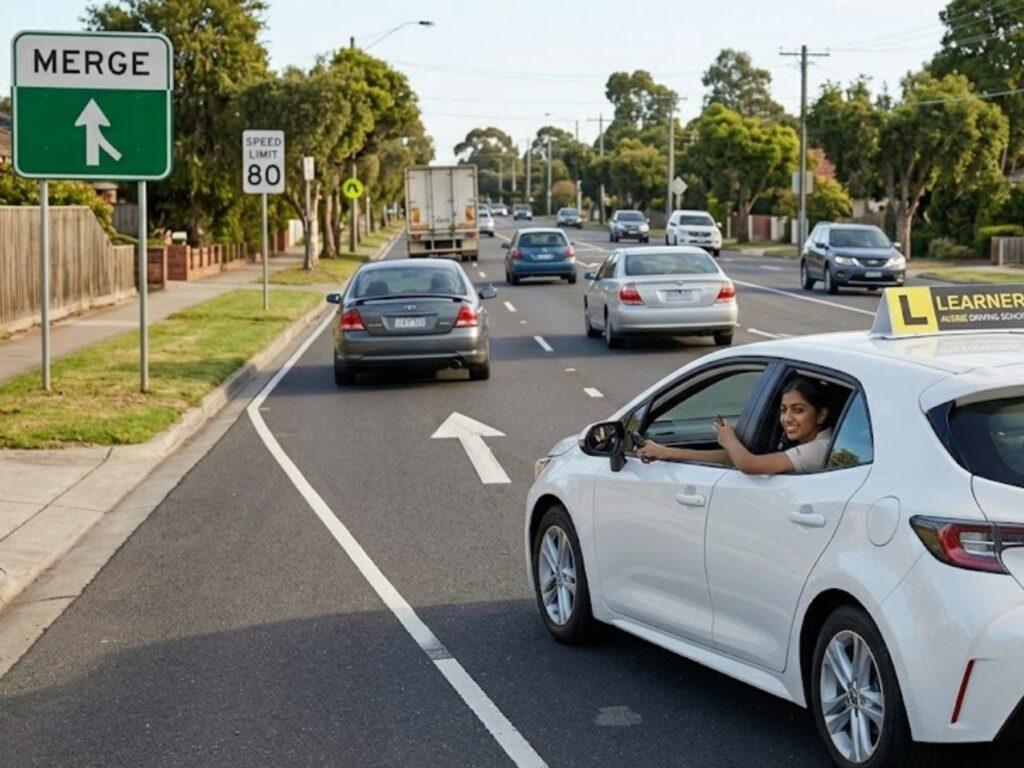
The Rule Most Victorian Drivers Are Getting Wrong
Victoria follows the Australian Road Rules under the Road Safety Road Rules 2017. The key section is Rule 148, and it is shorter than most people expect.
If your lane ends and you need to move into another lane, you give way to vehicles already in that lane. Simple enough. But here is where most drivers slip up.
Not every merge involves a lane ending. Sometimes two lanes run together, and both feed into one, with no dashed line separating them. That is a completely different rule, and it is common for drivers to get the zip merge confused with a lane change. Many assume the car on the left always has to give way to the right, but that is not the case.
The Zip Merge vs. the Lane Drop: Know the Difference
| Merge Type | What It Looks Like | Who Gives Way |
| Lane Drop | Your lane ends with a solid edge line or “lane ends” sign | You (driver in the ending lane) |
| Zip Merge | Two lanes taper into one, with no dashed line between them | The vehicle that is behind the other at the merge point |
| Freeway On-Ramp | You are entering from an on-ramp across a broken white line | You, to all through traffic |
A surprise quiz posted on the Melbourne subreddit brought back memories of the learner’s test for thousands of Melburnians. The scenario teased out the difference between a zip merge and a lane merge, and sparked a lively debate in the comments. Most people got it wrong, and these are licensed drivers on Melbourne roads every day.
Our tip: If you can see a dashed white line between you and the other lane, treat it as a lane change and give way. If there is no line at all and both lanes are tapering into one, the vehicle ahead of you goes first. Check the road surface before you check the other car.
Why Melbourne Roads Make Merging Harder Than It Should Be
Mixed Road Design Creates Confusion
Melbourne roads combine older streets with newer freeway upgrades. This inconsistency makes merging unpredictable and harder for drivers to judge safely.
Bell Street Is a Major Trouble Spot
Bell Street in Preston is known for frequent merging issues. Heavy traffic, multiple lanes, and constant stops at lights create pressure. Drivers often disagree on who has the right of way, leading to risky situations.
Freeways Struggle With High Demand
The Calder Freeway near Keilor and the Western Freeway around Melton face regular congestion. In some areas, only two lanes handle heavy traffic, and limited merging space forces drivers into tight decisions.
Short On-Ramps Increase Risk
Some entry points, like those on the M80 Ring Road, are short and steep. Drivers have little time to build speed before merging, which increases stress and the chance of mistakes.
Our tip: On a short ramp, accelerate earlier than feels comfortable. You want to reach the speed of freeway traffic while you are still on the ramp, not after you have already entered the lane. Braking mid-ramp is the single biggest mistake we see new drivers make at merge points.
Speed Matching Comes Before Gap Selection
Merging is not just about finding a gap. You need to match the speed of traffic first, then move into a gap smoothly.
Many drivers enter too slowly. According to IAG research on merging behaviour, drivers should match the speed of the traffic they are joining and avoid stopping in the merge lane, especially on freeways.
On roads like the Calder Freeway near Keilor or the Western Freeway near Melton, traffic often moves at 100 km/h. You should be close to that speed before merging. A gap that looks safe at 60 km/h will disappear quickly.
Avoid stopping on on-ramps such as those on the M80 Ring Road. It increases the risk of being hit from behind by drivers who are also trying to speed up.
Our tip: Look for the gap that will exist when you arrive at the merge point, not the gap that exists right now. A gap of 10 car lengths ahead of you may close completely before you get there. Project forward, not sideways.
Reading the Merge Before You Get There
Start planning your merge 200 to 300 metres before the merge point. Pick your gap, match your speed, and get ready to move in.
Indicate Early
Use your indicator for three to four seconds before merging. This gives other drivers time to adjust. It matters on busy roads like Dandenong Road, where traffic flow can change quickly.
Avoid Driving Side by Side
Do not sit next to another car as you approach the merge. It often happens without noticing and leaves you stuck with no space. If this happens, either speed up and go ahead or slow down and let the other driver pass.
💡Note: Never treat the merge point as the place where decisions happen. By the time you reach it, every decision should already be made. Your indicator should be on, your speed should be matched, and your gap should be committed. The merge itself should feel like a formality.
Wet Roads and Night Driving Change Everything
Victoria’s weather adds another layer. In wet conditions, your stopping distance increases substantially. The 3-second gap recommended for dry roads should expand to at least 4 to 6 seconds in rain, and that same logic applies at every merge point.
Night merging on unlit sections of the Ring Road or on the outer freeway edges near Melton or Berwick is underestimated by most drivers. Depth perception drops significantly. Judging the closing speed of a vehicle in your side mirror at night is genuinely harder than it looks in daylight.
Our tip: In wet or low-visibility conditions, we always recommend a larger gap than you think you need. It is far better to wait an extra second and merge cleanly than to commit to a gap that tightens as you enter it. Your indicators do more work at night, so use them earlier and longer.
What to Actually Do If You Feel Uncertain
Feeling unsure at merge points usually comes down to planning, not reaction time.
Start the Process Earlier
Calm drivers spot the merge about 300 metres ahead. They pick a gap, match speed on the ramp, and merge smoothly. By the time they steer, the move feels natural.
Get Practical Help if Needed
If merging on CityLink or the Eastern Freeway during peak hour still feels stressful while driving, consider booking one lesson specifically focused on freeway driving. One session where an instructor watches your mirror timing, your speed on the ramp, and your gap selection will correct more than hours of reading about it.
Bring the Right Approach
Knowing the rules is not enough. Stay focused and plan ahead. Merge with a clear decision, not guesswork.
Frequently Asked Questions
What is the actual fine for failing to give way when merging in Victoria?
In Victoria, failing to give way correctly when merging can cost you $198 and two demerit points. Fine amounts are reviewed by the Victorian Government each July and are subject to change.
That applies whether you failed to give way at a lane drop or pushed into a zip merge out of turn. So it is worth getting the rule right before it costs you.
Is it legal to speed up to stop another driver from merging into your lane?
No, and it is one of the more commonly misunderstood situations on Victorian roads. According to RACV, not speeding up when someone is merging or overtaking is not just a courtesy; it is required by law. Deliberately closing the gap on a merging driver can expose you to an obstruction or dangerous driving charge.
Do you need to indicate during a zip merge if there are no lane markings?
Yes, you still need to indicate. VicRoads confirms that even in a zip merge situation, the driver ahead must indicate, and failing to do so can result in a $198 fine and two demerit points. Most drivers assume the no-line rule removes the indicator requirement, but it does not.