

Most new drivers handle suburban streets fine. Then they get onto the Monash Freeway for the first time with cars flying past at 100 km/h, and suddenly the road test feels like training for a completely different situation.
One of the most common things new Victorian drivers say online is that nobody actually prepared them for freeway driving. They know the theory. They passed the test. But merging at speed, reading exits in time, and holding their line in fast-moving traffic? That is a different skill set altogether.
Here is what you genuinely need to know before you merge onto your first on-ramp.
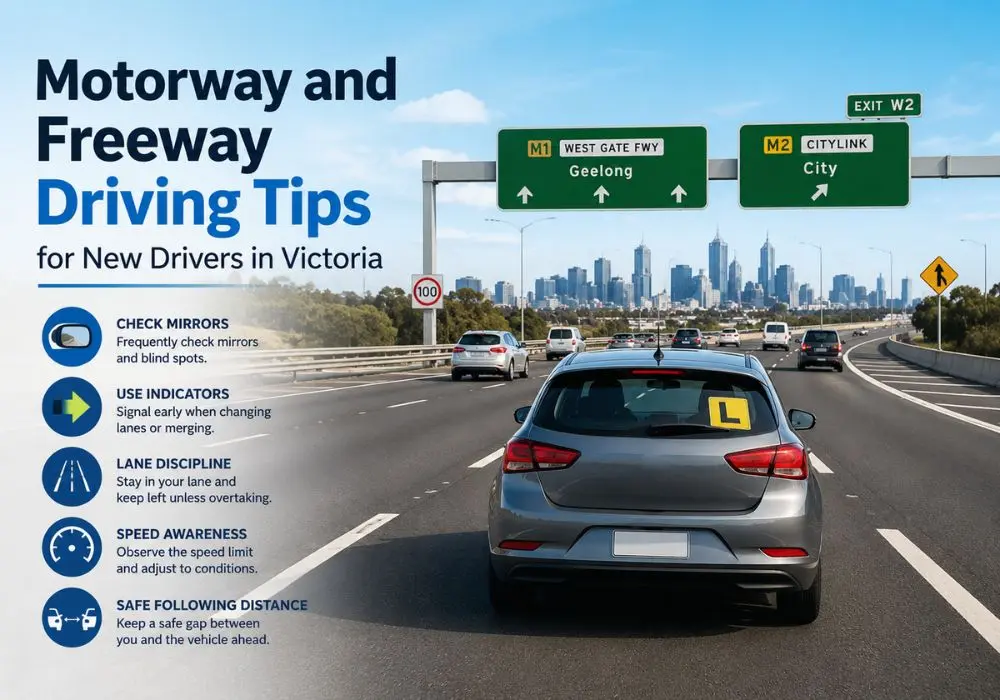
What Victorian Road Rules Actually Say for New Drivers
A lot of new drivers assume freeways are off-limits until they get their full licence. They are not.
In Victoria, learner drivers can legally drive on freeways and motorways. The only condition is that your supervising driver holds a full Australian driver’s licence and has held it for at least four years.
In terms of red P-plates, Victoria is actually one of the more relaxed states. There is no separate P-plate speed cap on freeways here. Victorian P1 drivers travel at whatever the posted limit is, typically 100 km/h, and up to 110 km/h on stretches where that is the signed limit, such as sections of the Hume Freeway.
That means you must still obey the posted speed, you just are not restricted below it the way P-platers in other states are. Compare that to New South Wales, where P1 drivers are capped at 90 km/h regardless of what the signs say.
The Toll Road Detail Most New Drivers Miss
CityLink and EastLink have no toll booths at all. You drive through, and if there is no Linkt account or day pass linked to your number plate, a fine arrives in the mail weeks later.
A standard day pass costs a few dollars and covers a single day of travel across both roads. Set it up online before you leave, not after you have already driven through.
| We always tell new drivers this first: Set up your Linkt account before your first trip on CityLink or EastLink. It takes five minutes online and saves you from a fine. |
The On-Ramp Is Where Most New Drivers Go Wrong
New drivers consistently report the same fear: the on-ramp. The car behind is approaching. Traffic on the freeway is moving fast. And the instinct is to slow down and wait for a gap.
That instinct works against you.
The on-ramp exists to give you space to match freeway speed before merging. As you enter the ramp, start accelerating toward freeway speed. Check your mirrors and over your shoulder. By the time you reach the end of the ramp, you want to be close to 90 to 100 km/h and slotting into a gap, not stopping and hoping someone lets you in.
If there is no gap immediately, adjust your speed slightly to create one. You do not stop on an on-ramp unless there is absolutely no other choice.
| We see this constantly with new drivers: They brake at the end of the ramp and wonder why merging feels so stressful. The fix is simple. Commit to accelerating early. Freeways feel much calmer once you arrive at merge speed instead of crawling into fast-moving traffic. |
Speed Awareness vs Speed Compliance
Staying at exactly 100 km/h in a 100 zone is legal. But if traffic is moving at 95 km/h because of congestion ahead, matching that flow is safer than closing the gap in front of you.
Equally, speed limits change on Victorian freeways. The Hume Freeway heading toward Wodonga climbs to 110 km/h in sections. Know the current limit, not just the one from 10 km ago.
| A habit we recommend: Glance at your speedo every 30 seconds until speed management becomes automatic. It will. It just takes time and repetition. |
Lane Discipline on Multi-Lane Freeways
Victorian road rules are clear. Keep left unless overtaking. On a two-lane freeway, you should be in the left lane unless you are passing someone.
A lot of new drivers sit in the right lane because it feels safer. Fewer entry and exit points, less merging. This is understandable, but it creates pressure behind you and is technically an offence on roads where the keep-left rule applies.
| We suggest this mindset shift: Think of the right lane as a passing tool, not a travel lane. Use it to overtake, then return left. Once that rhythm clicks, lane management stops feeling stressful. |
What to Do When Someone Tailgates You
Do not brake suddenly. Do not speed up to get away from them.
The best response is to move left when safe, let them pass, and continue at your own pace. If you are already in the left lane, maintain your speed and increase your following distance from the car ahead. This gives you a larger buffer and reduces how sharply you need to brake.
Following Distance at Freeway Speed
The two-second rule is the minimum in good conditions. At 100 km/h, two seconds is roughly 55 metres. In rain, low visibility, or when you are still building experience, three to four seconds is safer.
To check it, pick a fixed point on the road. When the car in front passes, count. If you pass the same point before reaching 1,002, you are too close.
| We always remind new drivers: The gap in front of you is not wasted space. It is your reaction time, and at freeway speeds, you need every metre of it. |
Exiting Without Cutting Across at the Last Minute
Freeway exits sneak up on new drivers, especially on unfamiliar routes. The Monash Freeway exits around Clayton and Chadstone come up quickly and can involve short ramp distances.
Use navigation, but also know the exit name and number before you leave home. If you miss your exit, do not brake hard and try to make it. Keep going, take the next exit, and reroute. That is always the right call.
Signal early when you move into the exit lane. Other drivers appreciate the communication.
| We hear about this one regularly: A new driver misses an exit, panics, brakes hard, and the car behind barely avoids a collision. Carry on past a missed exit every time. No destination is worth the risk of an emergency stop on a freeway. |
Night Driving on Victorian Freeways
This one matters more than most people realise. According to the Transport Accident Commission (TAC), first-year P-plate drivers in Victoria are seven times more likely to be killed or seriously injured when driving at night between 10 pm and 6 am compared to fully licensed drivers. On average, around 31 first-year P-platers are killed or seriously injured at night on Victorian roads each year.
Freeways at night look clear and manageable. But visibility is reduced, fatigue is a real factor, and hazards appear with less warning.
| We strongly recommend this: In your first three to six months on your Ps, avoid solo freeway trips at night where possible. If you need to do it, keep the trip short, take it at a relaxed pace, and stay off the road after midnight. The TAC data on this is hard to argue with. |
Driving in Rain and Low Visibility
Victorian weather can shift quickly, especially on exposed stretches like the Calder Freeway heading toward Bendigo or the Western Freeway near Ballarat.
When it rains, stopping distances increase significantly and tyre grip drops. Slow down, increase your following distance, and turn your headlights on. In Victoria, if visibility drops below 150 metres, headlights are legally required.
If you find yourself in heavy rain and genuinely feel unsafe, pull into a rest stop and wait it out. That is always an option, and it is the right one.
| We remind new drivers of this often: Hazard lights while moving on a freeway are not recommended. They make it harder for other drivers to read your indicators. Headlights on, speed down, gap up. That is the formula. |
Quick Reference: Victorian Freeway Basics
| Situation | What to Do |
| On-ramp | Accelerate to match freeway speed before merging |
| Lane choice | Stay left, use right only to overtake |
| Speed limit changes | Watch for signs on Hume, M80 and Western Freeways |
| Missed exit | Keep going, take the next one, reroute |
| Heavy rain | Slow down, increase the gap, headlights on |
| Tailgater | Move left when safe, never brake suddenly |
| CityLink or EastLink | Set up Linkt before you travel |
| Night driving on Ps | Avoid long solo trips between 10 pm and 6 am |
18 to 25 year olds make up about 10 per cent of Victorian licence holders but account for roughly 17 per cent of those killed on Victorian roads, according to TAC data. The most dangerous window is your first six to twelve months on your Ps.
That is not meant to scare you. It is meant to be honest with you. The freeway becomes very manageable with practice. But it rewards preparation and patience, not speed and overconfidence.
Do a few supervised freeway runs before you go solo. Try different times of day. Try the Monash at peak hour and the Tullamarine on a quiet Sunday morning. They are genuinely different roads at different times. Know both before you decide, you have it sorted.
Frequently Asked Questions
What should I do if my car breaks down on a Victorian freeway?
Steer left to the emergency stopping lane, turn your hazard lights on, and exit the vehicle from the passenger side, away from moving traffic. Call for roadside assistance from behind the safety barrier if one is present, and do not attempt any repairs yourself while on the freeway.
Can I use my phone for GPS while driving on L or P1 plates in Victoria?
No. Victorian learners and red P-plate drivers cannot use a mobile phone in any way while driving, including for navigation, even hands-free. Set your GPS route before you start the car, or use a separately mounted GPS device that you do not touch while moving.
Is there a legal night driving curfew for P-platers on Victorian freeways?
No, Victoria does not have a legal curfew for P-plate drivers, unlike Western Australia, where P1 drivers face restrictions between midnight and 5 am in their first six months. That said, the TAC’s data is clear: first-year P-platers in Victoria are seven times more likely to be killed or seriously injured driving between 10 pm and 6 am than fully licensed drivers, so limiting night freeway trips early on is strongly advisable even without a legal requirement.