

You see them every single day, but road markings are one of those things most drivers only think about when they’re unsure if what they just did was legal. Crossed a painted island at a roundabout exit?
Wondered whether those two solid white lines in the centre meant you could turn right? It’s a grey area for a lot of drivers, and getting it wrong in Victoria comes with real consequences.
Here is a plain-language breakdown of what the markings on Victorian roads mean, grounded in the Road Safety Road Rules 2017.
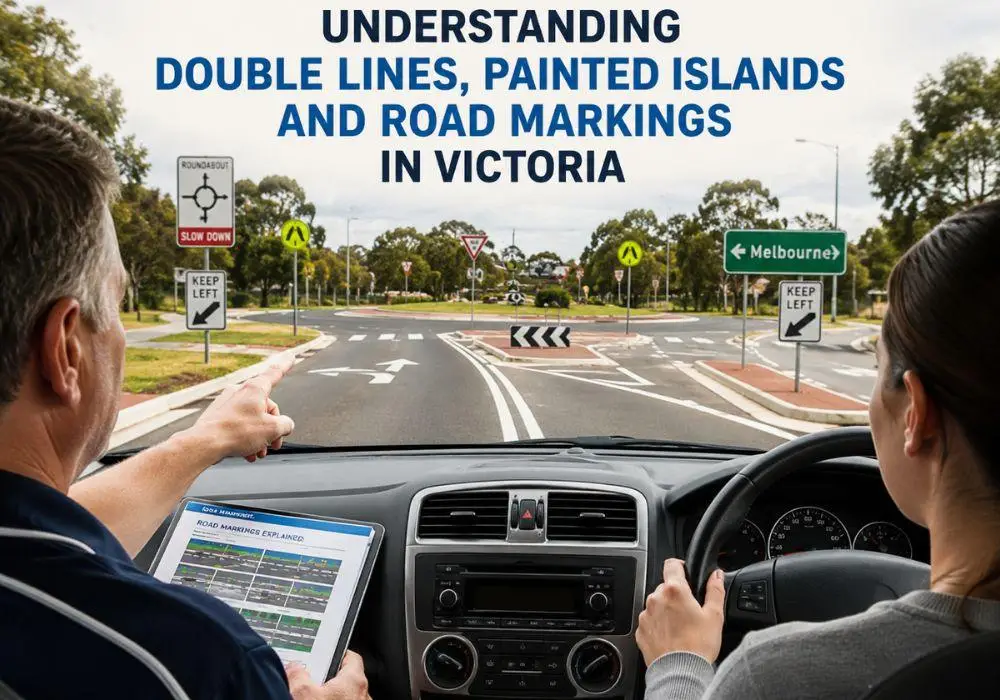
What Double Lines Down the Centre of the Road Mean
Two solid white lines running parallel down the middle of the road are the most restrictive type of dividing line in Victoria.
Under Rule 132 of the Road Safety Road Rules 2017, when there are double continuous (solid) dividing lines, you cannot cross them for any reason, not to overtake, not to turn, and not to perform a U-turn. The only exception is if you need to avoid an obstruction that is blocking the road, and even then, it must be safe to do so.
You are not allowed to cross over double continuous lines for any reason, unless you have to avoid an obstruction and it is safe to do so. You cannot overtake, turn, enter or leave the road across double lines.
That last part trips a lot of people up. Even entering or leaving a property or side road is not permitted when double continuous lines are present, unlike with a single continuous line, where entering or leaving a road is still allowed.
The Six Types of Dividing Lines in Victoria
Here is how each type works in terms of what you can and cannot do:
| Line type | Overtake? | U-turn? | Enter/leave the road? |
| Broken (dashed) | Yes | Yes | Yes |
| Single continuous | No | No | Yes |
| Broken to the left of continuous | Yes | Yes | Yes |
| Broken to the right of continuous | No | No | Yes |
| Double continuous | No | No | No |
| Double broken | Yes | Yes | Yes |
The combination lines, one solid and one dashed, are what catch drivers off guard.
If the solid line is on your side (the left), treat it as a single continuous line. You cannot overtake or U-turn. If the dashed line is on your side, you have more flexibility, but you still need a clear view and safe conditions.
This table reflects Rules 132, 134 and 139 of the Victorian Road Safety Road Rules 2017.
Painted Islands: Two Very Different Situations
A painted island is the striped or chevron-marked area on the road surface, usually appearing at intersections, freeway entry points, or where lanes diverge. The rules for them depend entirely on what kind of line surrounds the island.
Painted traffic islands are striped, irregularly shaped patches of road that assist with traffic separation and direction. There are restrictions about when motorists are permitted to drive on such traffic islands, and incorrectly doing so has been flagged as one of the most common bad habits of drivers in Victoria.
Freeway On-Ramps and Slip Lanes
There is a specific rule worth knowing here. You must not drive over a painted island at a freeway on-ramp or slip lane. Even if a painted island at a freeway on-ramp or slip lane is surrounded by a single continuous line, the usual permission to cross it does not apply.
The exception that allows crossing a single continuous line to enter a turning lane does not extend to painted islands at merge points or slip lanes. You cannot drive over them.
So if you are approaching a right-turning lane and a painted island sits just before it, you can cross into the island to access that turning lane. That is the intended use. What is not permitted is using the island as a shortcut, cutting through it at an intersection, or rolling across it because it seems like the quicker path.
Islands Surrounded by Double Lines
This is where there is zero flexibility. You must not drive in areas surrounded by double lines.
Rule 138(1) of the Road Safety Road Rules 2017 covers this, and the penalty is 1 demerit points, confirm the current figure against the Department of Transport and Planning’s official penalty schedule before publishing. That is a significant hit, particularly for learner or probationary licence holders who have lower demerit thresholds.
Freeway On-Ramps and Slip Lanes
There is a specific rule worth knowing here. You must not drive over a painted island at a freeway on-ramp or slip lane.
This applies regardless of what type of line surrounds the island. The island on a freeway on-ramp or slip lane is there to separate traffic entering from traffic already travelling. Driving over it, even briefly, is an offence under Rule 138 of the Road Safety Road Rules 2017.
Lane Lines Are Different from Dividing Lines
Lane lines sit between lanes travelling in the same direction. They are white and either broken or continuous. Most drivers understand that a broken lane line means you can change lanes, but the continuous lane line catches people out.
You cannot change lanes over a single continuous lane line, including those approaching traffic signals.
The exceptions are narrow. You can cross a continuous lane line to avoid an obstruction on the road, to obey a traffic device, or to move to or from a special-purpose lane like a bus or bike lane, if you are permitted in that lane.
One thing worth noting for freeway driving specifically: at some locations, such as on freeways, long lines with short gaps are used. These markings are to discourage unnecessary lane changes. Due to the repeated nature of the lines and breaks, they’re considered to be broken lines.
So on roads like the Western Ring Road or the Monash Freeway, where you see those extended lines with small gaps, they are technically broken. But the intent is still clear: stay in your lane.
Keep Clear Markings and Yellow Edge Lines
Two other markings that confuse drivers, particularly newer ones.
Keep Clear. These are the large painted words or boxed markings at intersections and access points. Under Rule 96 of the Road Safety Road Rules 2017, you must not stop in these areas. It is not about whether traffic is moving; even if you are stationary in a keep clear zone due to congestion, you are in breach.
Continuous yellow edge line. A yellow edge line along the left side of the road means no stopping at any time. This is different from a white edge line, which marks the boundary of the driving lane. If you see yellow on the kerb or road edge, treat it as an absolute no-stopping zone.
Read more: How Speed Zones Work in Victoria and Common Mistakes Learners Make
About the Fines
Getting any of these markings wrong is a demerit point offence in most cases.
Here is what is on the table under the Road Safety Road Rules 2017, using the current Victorian penalty unit value of $203.51 (in effect from 1 July 2025 to 30 June 2026, per Victoria Legal Aid).
| Offence | Demerit points | Penalty units |
| Cross or drive to the right of double continuous dividing lines | 3 | 2 penalty units |
| Drive on/over the painted island with double lines (Rule 138) | 1 | Listed under Rule 138(1) |
| Cross a single continuous lane line improperly | 0 | 1 penalty unit |
| Fail to keep left of the centre of the road | 2 | 1.25 penalty units |
For a learner permit holder in Victoria, 3 demerit points is a serious accumulation. The limit before suspension for a learner is just 4 points within any 12 months.
Note: penalty unit values are indexed annually on 1 July. Verify the current rate at Legal Aid Vic.
The Bicycle Overtaking Exception
You are allowed to cross dividing lines, including solid and double lines, and drive on painted islands when passing a bicycle rider, but only if you can do so safely and have a clear view ahead. This exception applies to dividing lines between opposing traffic lanes, not to lane lines separating lanes travelling in the same direction.
This rule applies in Victoria and is aimed at reducing cyclist injuries caused by vehicles passing too close.
The key conditions are a clear view ahead with safety. It is a narrow exception for a specific situation.
The Marking-Related Errors That Come Up Most Often
- Crossing into a painted island at a freeway on-ramp when merging
- Treating the long-gap freeway lane lines as continuous when they are technically broken
- Forgetting that double continuous dividing lines mean you cannot even enter or leave the road across them
- Not giving way when crossing into a turning lane from a painted island
The road rules governing all of this sit in Parts 8 and 11 of the Road Safety Road Rules 2017. The Department of Transport and Planning (formerly VicRoads) is the administering body, and the RACV provides a practical summary aligned to those rules if you want a plain-English reference to cross-check against.
On roads like Springvale Road in Melbourne’s south-east, or the Hume Highway through regional Victoria, the markings change context quickly.
Rural stretches with single continuous lines, then arterial roads with painted islands and slip lanes within a few kilometres of each other. The rules stay the same. The environment keeps changing.