

Most learner drivers treat lessons as the only time they improve. They show up, drive for an hour, then park the car and wait until next week.
That gap is where real progress either happens or stalls.
That gap between lessons is where real progress either happens or stalls. Supervised practice between lessons is where skills actually stick. Your instructor builds the foundations. Private practice is where those foundations become habits. Skip one, and you slow yourself down considerably.
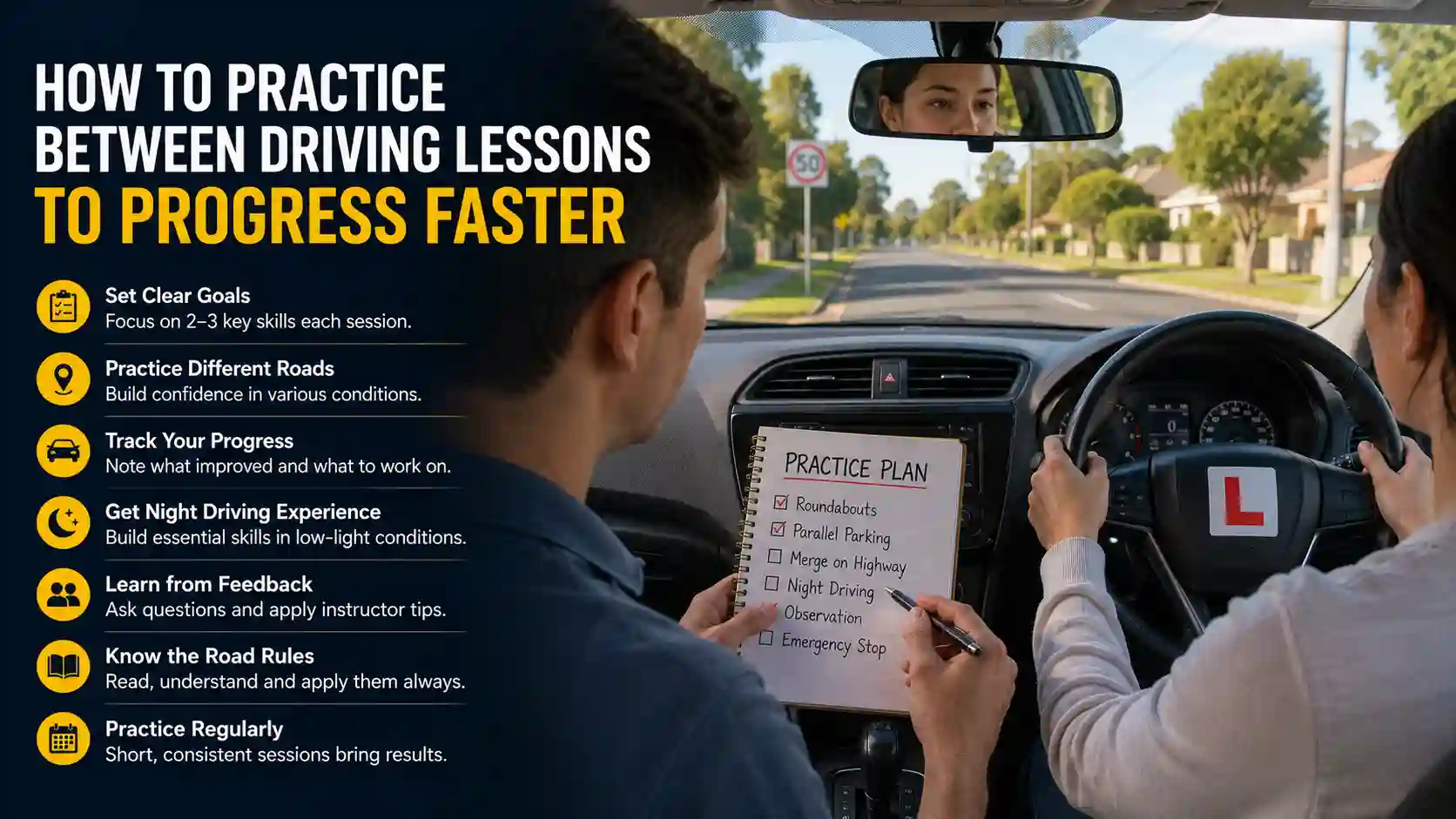
Step 1: Structure a Private Practice Session
A private session is not the same as going for a drive. There is a difference between clocking hours and building skills.
Before you start, agree on the goal for the session with your supervisor. Keep it focused. Two or three skills per session are enough.
A useful structure to follow:
- Warm up on familiar roads for the first 10 minutes. Let your hands and feet settle back into the car.
- Target the specific skill your instructor flagged. Repeat it until it feels natural, not just once.
- Introduce one new challenge in the final third. A new road type, an unfamiliar roundabout, or a busier intersection.
- Debrief at the end. Pull over and talk through what went well and what needs attention. Do not skip this step.
Research in driver education consistently shows that short, focused sessions targeting one or two skills at a time produce better retention than long, unfocused drives. You do not need three-hour sessions. You need regular, targeted practice a few times a week.
Step 2: Get Clear Instructions Before You Leave Each Lesson
Do not wait until you are home to think about what to practise. Ask your instructor at the end of every lesson, before you get out of the car.
A simple question works: “What should I focus on before our next session?”
A good instructor will give you two or three specific areas. These might include smooth braking, checking mirrors before turns, or holding a consistent following distance
Write it down in your phone immediately. This gives you clear direction for your next private session, not a vague plan to “get more practice.”
| Pro tip: In Victoria, VicRoads assesses your ability across observation, hazard perception, vehicle control, and compliance with road rules during the Hazard Perception Test and the practical drive test, including manoeuvres like reverse parallel parking. Ask your instructor which areas still need work. |
Step 3: Build Up Road Types Gradually
One of the most common mistakes learner drivers make is sticking to familiar streets. Comfortable does not mean competent.
Work through road types as your confidence grows:
- Quiet residential streets with low traffic
- Suburban roads with traffic lights and roundabouts
- Main roads and multi-lane traffic
- Arterial roads during peak hour
- Motorways and highway driving
- Night driving once you are confident in daylight
VicRoads recommends spreading practice across the full learner period rather than cramming before the test. Weekly practice on different roads and in different conditions, including wet weather, peak hour, and nighttime, is what builds genuine competence.
If you live in a regional area, you also get time on unsealed roads and open country roads.
Regional and rural young drivers in Victoria are significantly over-represented in serious road trauma compared to metropolitan drivers, according to Victorian road safety data.
Step 4: Track Skills
Your logbook records time. But time without intention does not reliably build skill.
Keep a short note after each private session in your phone or a notebook.
- What did we practise?
- What improved compared to last time?
- What still needs work?
Bring that note to your next lesson. Your instructor can then focus the session on what you flagged rather than guessing where to start. This connects your private practice and your paid lessons into one continuous process.
| Session Focus | What Improved | What Needs Work |
| Roundabouts on a main road | Correct give-way, good observation | Entry speed still too slow |
| Parallel parking in a car park | Smoother overall | Kerb distance on second attempt |
| Night driving in the suburbs | Comfortable at 60 km/h | Mirror checks not frequent enough |
Step 5: Night Hours
Many automatic driving learners delay night driving because it feels harder. That is exactly why you should not put it off.
In Victoria, you need at least 20 logged night driving hours as part of your 120-hour logbook. Night driving builds a different set of skills, including reading oncoming headlights, judging distances in low light, and spotting pedestrians near shopping strips and entertainment precincts.
Start short. A 20-minute drive around familiar streets after sunset with your supervisor is a solid first step. Gradually extend to longer routes and less familiar areas.
| Pro tip: Driving through a busy area on a Friday or Saturday night is a challenge. Avoid it early on. But do not avoid it forever. That kind of experience is exactly what separates a prepared driver from one who only ever practised in daylight on quiet streets. |
The Mental Side of Practice
Watch dashcam footage from Australian roads on YouTube. Pay attention to how experienced drivers scan intersections early, check mirrors before lane changes, or ease their speed on approach to roundabouts.
This builds hazard perception, which is the ability to read what is developing ahead rather than just reacting to it.
Hazard-perception research has repeatedly found that learner drivers exposed to real crash footage and complex traffic scenarios build stronger mental models of the road environment than those who rely on on-road hours alone.
Their ability to anticipate and respond to hazards improved measurably, even before additional on-road hours were completed.
Spend 10 minutes the night before a session watching local traffic footage. It sharpens your mental picture before you turn the key.
Also, read the Victorian road rules handbook thoroughly. A significant number of practical test failures come from rule knowledge gaps, not driving ability. Know what a give-way line means in practice. Understand when you cannot cross a continuous centre line.
Why the Gap Between Lessons Matters
Young drivers aged 17 to 24 are significantly over-represented in fatal and serious injury crashes relative to their share of licence holders, according to Victorian road safety data. The primary cause is inexperience, not recklessness.
Experience is built through volume. Consistent, structured practice across a wide range of road conditions is what reduces that risk.
A weekly one-hour lesson gives you roughly 50 hours of in-car time over a year. In Victoria, you need 120 logged hours before you’re eligible to sit your practical test.
Victoria also has a 3-for-1 bonus hours scheme for lessons with a qualified instructor, which can reduce the total time needed behind the wheel. Check the current cap on bonus hours with VicRoads, as this is worth confirming before you rely on it for your logbook planning.
How Often Should You Practise?
Aim for at least two to three sessions per week. Sessions do not need to be long. Even 20 to 30 minutes of focused driving is more valuable than one two-hour session every seven days.
Consistency builds muscle memory. Spacing practice across multiple days gives the brain time to consolidate what it learned. Skills stick better when they are practised in shorter, regular intervals.
If your lessons are fortnightly, aim for four to six private sessions in between. Talk to your supervisor about setting a regular weekly schedule.