

Speed zones trip up a lot of learner drivers, not because the rules are complicated, but because most people wait for a sign to tell them what to do. This guide breaks down every speed zone type in Victoria, the default limits that apply without signs, and the mistakes to avoid before your test.
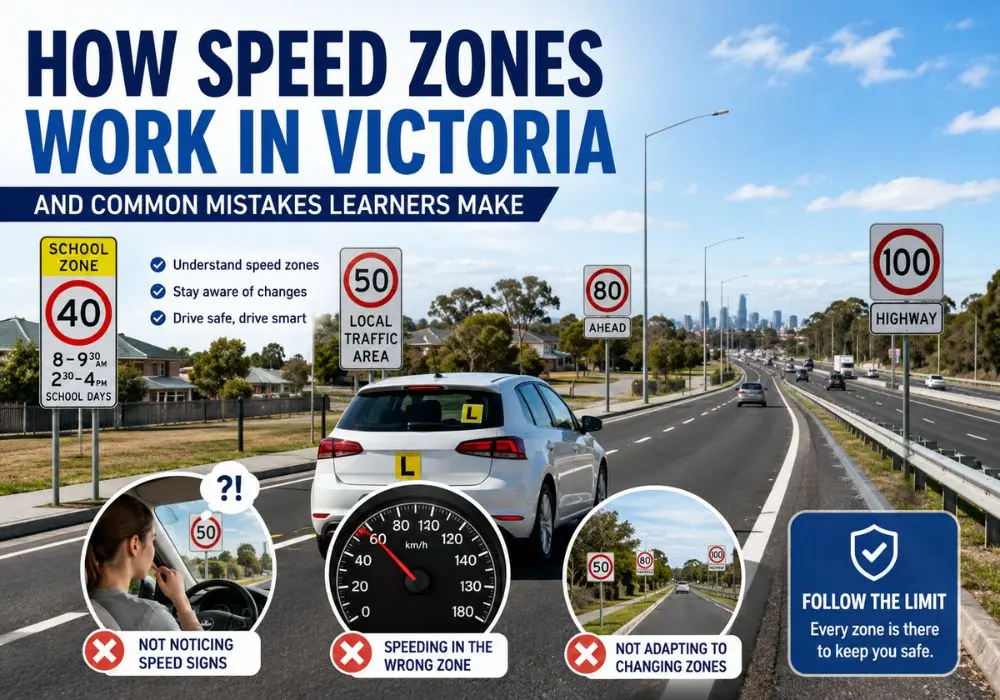
The Default Limits That Apply Even Without a Sign
VicRoads sets two default speed limits that apply whenever there’s no sign posted. These are not optional guidelines. They are legally enforceable under the Road Safety Road Rules 2017 (Victoria).
50 km/h is the default in built-up areas. A built-up area is any street with development, lighting, or buildings on both sides of the road. Most suburban streets in Melbourne and across Victoria fall into this category.
100 km/h is the default on all other roads outside built-up areas, including unsealed country roads and rural highways without signage.
When you see a speed limit sign, that limit applies for the entire length of the road following that sign until you reach a sign with another speed limit, an “end speed limit” sign, or the end of the road if it concludes at a T-intersection or dead end.
| We see this come up constantly with new learners: The moment there’s no sign, many learners assume the limit is whatever feels right for the road. It isn’t. The default 50 km/h applies whether the sign is missing, obscured by a tree, or simply not required. If you can’t see a sign and you’re in a built-up area, 50 is your number. |
Every Speed Zone Type in Victoria
25 km/h Shared Zones
These apply in pedestrian-priority areas: some CBD laneways, parts of Bourke Street Mall, and designated shared zones. Pedestrians have the right of way. Most learners don’t slow to 25 naturally because it feels slower than the traffic around them.
40 km/h School Zones
In Victoria, school zones operate on school days from 8:00 am to 9:30 am and from 2:30 pm to 4:00 pm. The reduced limit is 40 km/h on roads where the regular posted limit is below 80 km/h.
On roads posted at 80 km/h or above, the school zone limit is 60 km/h instead. Flashing lights on signs mean the zone is active. If signs show times or dates, they apply even if no children are visible.
Speed cameras in school zones are active throughout those hours. A speeding offence in a Victorian school zone starts from $254 for less than 10 km/h over the limit, rising to $407 and 3 demerit points for 10–24 km/h over. Fine amounts are updated every July. Check the current Victorian schedule.
| Note: Some schools in active-travel precincts or on roads with limited pedestrian infrastructure have a 30 km/h school zone limit. Always observe the speed shown on the sign. |
For a full breakdown of school zone rules, cameras, fines, and common mistakes, see our guide: [School Zone Rules in Victoria: What Every New Driver Must Know].
| We tell every learner the same thing about school zones: Don’t look for kids to decide if the zone is active. Look at your clock. If it’s a school day and the time falls inside those windows, you’re in a school zone. Full stop. |
50 km/h Suburban Streets
The standard residential default. Most local roads in Melbourne suburbs sit at this limit. Because it’s the default, signs aren’t always present. Learners need to read the environment, not wait for a sign to appear.
60 to 70 km/h Arterial Roads
These apply to busier main roads connecting suburbs, shopping strips, and transitional zones near the urban fringe. Both are signed. The 70 zone is easy to miss because it’s less common and often appears briefly before a faster road.
80 to 90 km/h Zones
Found near construction areas, outer highway sections, and roads approaching freeway entries. Always signed. Pay attention when entering this type of road, as the limit can change multiple times in a short distance.
100 and 110 km/h Open Roads
Country highways and Melbourne’s ring roads sit at 100 km/h in most sections. Parts of the Hume Freeway and Calder Freeway are signed at 110 km/h. Some freeway sections near exits and merge zones drop to 80 km/h, clearly signed.
Speed Zone Reference Table
| Zone | Where You’ll Find It | Signed or Default? |
| 25 km/h | Shared zones, CBD laneways | Signed |
| 40 km/h | School zones, some pedestrian areas | Signed + time-based |
| 50 km/h | Suburban streets, built-up areas | Default (often unsigned) |
| 60 km/h | Arterial roads, shopping strips | Signed |
| 70 km/h | Transitional roads near urban edges | Signed |
| 80 to 90 km/h | Some outer highways, construction zones | Signed |
| 100 km/h | Country highways, most freeways | Default outside built-up areas |
| 110 km/h | Selected freeways (e.g. parts of the Hume Freeway) | Signed |
Common Mistakes Learners Make in Speed Zones
Assuming the Limit Only Changes When a New Sign Appears
Speed limits change at suburb boundaries, intersections, and near schools without always having a visible sign ahead. The transition from built-up to non-built-up area changes the default automatically. You have to read the environment alongside the signage.
Slowing Down Too Gradually After Passing a New Sign
The new speed applies from the sign onwards, not before. Drivers sometimes accelerate early or brake too late, which can result in penalties. Your speed must match the zone the moment you pass the sign, not 150 metres later.
| We pay close attention to this during lessons: Many learners coast into a lower zone doing 5 or 10 km/h over the new limit. In a driving test, that’s a notable error. In a school zone, it could be a fine. The habit to build is acting on the sign immediately, not eventually. |
Treating School Zones as All-Day Rules
Plenty of learners know school zones are 40 km/h, but apply that limit all day, regardless of the time. The reduced limit only applies during the morning and afternoon school windows on school days. A Saturday drive past a school is just a regular 50 km/h road.
Confusing Advisory Signs With Legal Speed Limits
A regulatory speed sign is white with black text in a red circle. An advisory speed sign is yellow with black text. Advisory signs guide the appropriate speed for a curve or hazard area, not the legal limit for that road.
A lot of learners see a yellow “35” sign on a corner and think the limit has dropped to 35. It hasn’t. The advisory sign is a safety recommendation. The actual legal limit stays in effect until a regulatory sign changes it.
| We specifically test learners on this before their test: The yellow diamond shape is the key. If it’s yellow, it’s advice. If it’s the white and red circle, it’s the law. Getting these mixed up during a test or on the road will cost you. |
Driving Too Far Under the Limit on Country Roads
You are legally required to drive at a speed appropriate to the conditions, but driving excessively slowly on open roads can be dangerous when traffic expects a normal flow.
Learners who are nervous on country highways and sit at 70 km/h in a 100 zone can create real hazards when other vehicles build up behind them. You don’t have to hit 100, but be aware of the traffic around you and manage your speed sensibly.
The Demerit Point Risk Most Learners Underestimate
Victorian learner permit holders operate on a 4-demerit-point threshold before suspension, lower than the 5-point threshold that applies to probationary (P-plate) drivers.
A single speeding offence in a school zone can cost 3 points. Two school zone offences, and your permit is gone. There is no official tolerance buffer for learner drivers, so accuracy matters far more than it does for fully licensed drivers.
| We remind every learner of this before they log their first freeway hour: 5 points sounds like a lot until you do the maths on school zone fines. It’s not a margin that allows for careless speed management. |
Frequently Asked Questions
Does the 50 km/h default speed limit apply in car parks in Victoria?
Speed limits apply in any road-related area, which includes car parks and any area open to the public for driving, riding, or parking. If no sign is posted inside a public car park, the default 50 km/h applies, though in practice most car parks have their own lower posted limits.
Can a Victorian learner driver do 100 km/h or 110 km/h on a freeway?
According to VicRoads, there is no set speed cap for Victorian learner drivers. You must drive within the posted speed limit for the road you are on. So yes, if the freeway is signed at 100 km/h or 110 km/h and your supervising driver agrees it is safe, you can legally drive at that speed. This is different from NSW, where learners are capped at 90 km/h.
Does the 40 km/h school zone limit still apply on student-free days?
Reduced school zone limits apply on a designated school day, even if the school is closed for a student-free day or other activity. The rule follows the school calendar set by the Victorian Department of Education and Training, not whether students are physically present that day.