

School zones are one of the easiest places to pick up a fine in Victoria, not because the rules are complicated, but because drivers assume they know them.
This guide covers the speed limits, operating hours, fines, and parking rules every driver needs to get right before going near a school.
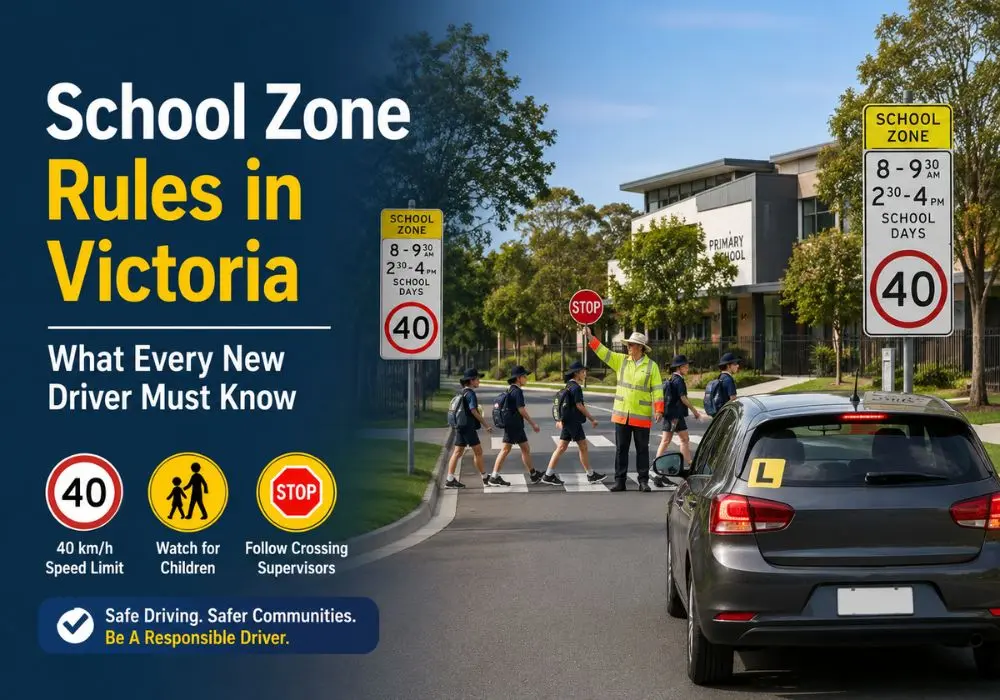
When the School Zone Is Actually Active
School zones operate from 8:00 am to 9:30 am and 2:30 pm to 4:00 pm on weekdays during school term. They do not apply on weekends, public holidays, or during school holiday periods.
Simple enough. But here is where the real-world confusion starts, and where thousands of Australian drivers get caught every year.
The Student-Free Day Trap
This is one of the most common questions we see from new drivers, and it has a costly answer.
It’s easy to assume the zone is inactive when your children are still at home, but the rules don’t care about that. Data shows that 2,184 fines were issued to drivers in just two days before Term 1 started in 2024, on January 30 and 31, when schools had student-free days, but the zones were fully active.
Reduced limits apply on a designated school day even if the school is closed for a student-free day or other activity.
The sign is what governs, not whether kids are physically at school. Cameras are live. Fines go out.
| We recommend this simple rule: If it’s a weekday during school term, treat every school zone as active between 8:00 am and 9:30 am, and again from 2:30 pm to 4:00 pm. Do not assume the zone is off just because the school car park looks quiet. |
Private Schools and Different Term Dates
School zone speed limits apply every weekday within the term school dates published by the Department of Education.
But private schools sometimes run on different calendars. If you regularly drive near a private school, check their specific term dates. The zone follows the school’s schedule, not the state government’s general one.
Victorian Fines and Demerit Points
Victorian speeding fines apply equally whether you’re in a school zone, a shopping strip, or a highway. The penalties are based purely on how far over the speed limit you were travelling.
Here’s a breakdown based on figures current as of 1 July 2025:
| How Far Over the Limit | Fine | Demerit Points |
| Less than 10km/h | $254 | 1 point |
| 10 to 24km/h over | $407 | 3 points |
| 25km/h or more over | Up to $1,018 | Mandatory licence suspension |
Amounts are reviewed and adjusted each July. Check updated fine amounts and demerit points.
Exceeding the school zone limit by 25km/h or more triggers mandatory licence suspension independent of the demerit point system. The suspension applies automatically when the fine is processed.
In a 40km/h zone, that means 65km/h gets your licence suspended automatically. That’s a speed that would feel normal on many suburban roads.
What This Means If You’re on a P or L Plate
Drivers with a full licence have a limit of 12 demerit points in any three years. Probationary drivers (P1 and P2) are suspended at 5 points within any 12-month period. Learner permit holders have an even lower threshold, just 4 points in the same 12 months.
Three points for one school zone offence takes a P-plater past the halfway mark of their annual limit. For a learner, it puts them three-quarters of the way to suspension. One more minor offence and either licence is gone.
| We see this regularly with new drivers: They think demerit points only matter after a few offences stack up. But on a P-plate, a single lapse near a school can genuinely end your driving for months. It’s worth taking that seriously before it happens. |
Victoria is one of the states that doesn’t apply double demerit points at any time of the year, which is at least one thing in your favour compared to NSW or WA drivers.
Children’s Crossings Rule
Children’s crossings can be recognised by bright orange “Children Crossing” flags. Whenever those flags are displayed, road users must stop for any pedestrians waiting to cross. This applies regardless of whether a crossing supervisor is present.
We see this question come up constantly. The flags are the trigger, not the supervisor. If a crossing supervisor is not there but the flags are still out, you still stop.
Failing to stop at a school crossing is a serious offence and can result in substantial fines and demerit points.
| We always make this clear in practical lessons: Look for the orange flags as you approach, not just the road markings. The flags can be out even if there’s no one visibly crossing yet. If the flags are displayed, come to a complete stop and wait. |
Parking Near Schools: Kiss and Go Zones Explained
Once you’re near a school at pick-up or drop-off time, you’re dealing with a mix of signs that genuinely confuse experienced drivers. No Stopping, No Standing, No Parking, and Kiss and Go zones can all appear within a short stretch.
“Kiss and Go” zones are designated areas at some schools where drivers can drop off students safely without leaving their vehicles. You cannot park in these zones, and motorists generally must remain no longer than two minutes.
If a sign says No Stopping, you cannot pull over at all, not even for ten seconds to let someone out. No Parking means you can stop briefly but must stay within arm’s reach of your car and leave within two minutes.
| We tell learners this before their first school run: Read every sign independently. Don’t assume the rules at one school apply at another. Some schools publish their own drop-off guides. If yours does, read it before you ever park nearby. |
The Stat That Puts It in Perspective
According to the Transport Accident Commission (TAC), around nine children aged 0 to 15 die each year on Victorian roads.
Children are still developing key skills such as depth perception, speed judgement, and hazard awareness, which can make it harder for them to accurately assess traffic risks.
They may step out without looking. They may misjudge your speed. They may chase something onto the road. As the driver, you are the one who needs to account for that.
A defensive driving lesson teaches you how to read these unpredictable situations earlier and create more space around school zones.
Before you drive near any school in Victoria, run through this quickly:
- Is it a school day in the Department of Education term calendar?
- Is the time between 8:00 am and 9:30 am, or between 2:30 pm and 4:00 pm?
- Have you slowed to 40km/h as you approach the sign, not as an afterthought once you’re through it?
- Are there orange crossing flags out?
- Do you know whether you’re in a No Stopping or a Kiss-and-Go zone?
If your answers are solid, you’re in good shape. If you’re unsure about any of them, sort that out before you drive the route, not while you’re already on it.
Frequently Asked Questions
How close can I legally park to a school crossing in Victoria?
It is illegal to park within 20 metres before or 10 metres after a school crossing point in Victoria. This applies even outside school zone hours, so don’t assume you’re clear just because the zone isn’t active.
Does Victoria have higher fines specifically for school zones, like in NSW?
Victorian Police confirmed that they “do not have extra fines or demerits within school zones.” Unlike NSW, which roughly doubles standard speeding fines in school zones and applies additional demerit points on top of that, Victoria’s fines are based purely on how far over the speed limit you were, regardless of location.
Can L and P-plate drivers touch their GPS or phone while driving through a school zone in Victoria?
Learner, P1, and P2 drivers must not touch their device at any point while driving, even at a traffic light, which means navigation must be fully set up before the car moves. If you need to change a destination or adjust audio near a school, you must pull over and park first.