

Most new drivers think the goal of lesson one is simply to survive it.
That is the wrong mindset. The habits you form in your first few hours behind the wheel are remarkably sticky.
Here, we break down what you need to practice from the first lesson to build good habits.
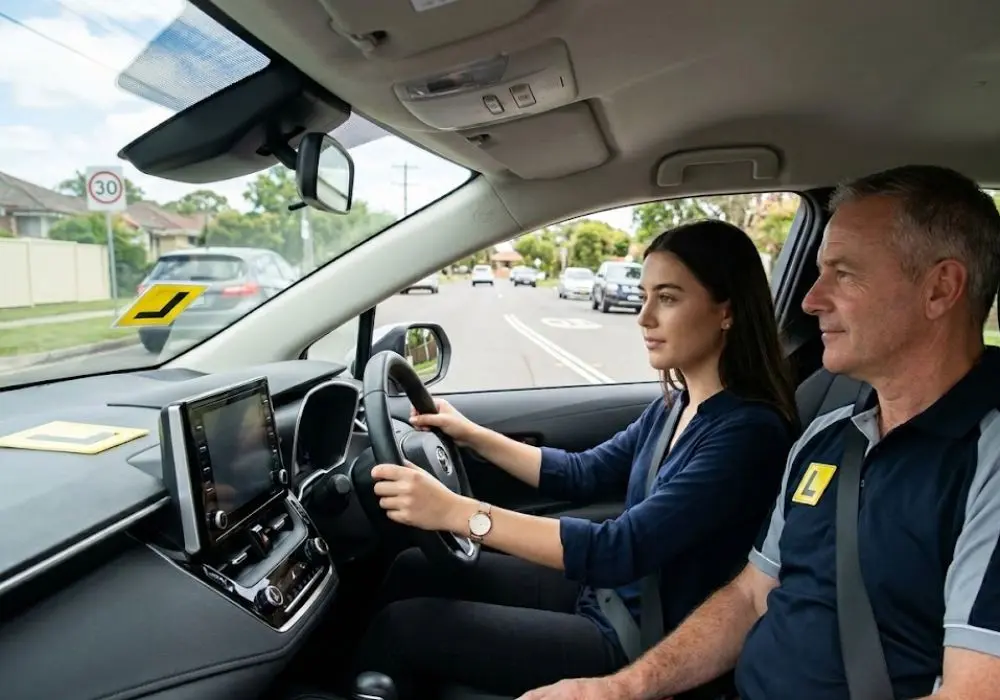
Your First Lesson Sets the Template for Everything After
The habits you build in your first few hours behind the wheel are remarkably sticky. Early-stage learners face serious risks on Australian roads, with drivers aged 17 to 25 accounting for around 16% of road fatalities despite being a small share of total licence holders, according to the Australian Road Safety Foundation.
What you practise under low pressure is exactly what you reach for automatically when things get stressful. That is why starting right matters more than most learners realise.
Set Up Your Seat and Mirrors Before You Touch the Ignition
A common complaint on Australian learner driver forums is this: “My instructor mentioned mirrors once and never brought it up again.” That gap in repetition is a real problem.
Your seat position directly affects your braking ability. If your knee is nearly straight when the brake is fully pressed, you lack the leverage needed for a firm emergency stop. Your back should rest flat against the seat, not hunched forward.
Set your mirrors so the full rear window is visible in the interior mirror. Each door mirror should show just a sliver of your own car along the inner edge. This confirms they’re angled outward enough to cover your blind spots.
Check them every five to eight seconds while moving.
| We Recommend: The 30-Second Pre-Drive Check Before every single drive, run through this sequence: adjust your seat, set your mirrors, position your headrest at eye level, and fasten your seatbelt. Do it before your instructor reminds you. Do it until it requires zero thought. |
Looking Ahead Is a Skill, Not Just Good Advice
A recurring frustration among new drivers is fixating on the road directly ahead.
Experienced drivers scan 12 to 15 seconds ahead, which at 60 km/h is roughly 200 to 250 metres down the road. This gives your brain time to process, decide, and act without panic.
In Sydney’s suburban grid, Melbourne’s hook turns, and Brisbane’s busy residential streets, parked cars pull out without warning and pedestrians step off kerbs mid-block. Scanning early is not a cliche. It is a practical skill that separates reactive drivers from composed ones.
| We Recommend: Train the Scan Pick a fixed object in the distance each time you drive, such as a set of traffic lights or a building ahead.. This trains your eyes to look further ahead naturally, rather than staring at the road directly in front of you. |
Smooth Inputs Matter More Than Fast Reflexes
Smooth inputs come from anticipation. When you spot a red light 150 metres ahead, you should already be easing off the accelerator. When you turn into a side street, reduce your speed before the turn, not during it.
This approach is central to the “limit point” technique taught in advanced driver training programmes. It means adjusting your speed based on how far ahead you can see around a curve, rather than reacting to what is already beside you.
Jerky braking and sharp steering are the footprints of a reactive driver. Smoothness is the goal from lesson one.
Build a Consistent Intersection Routine Every Single Time
Intersections are where most urban crashes happen. According to Austroads, intersection-related incidents account for approximately 30% of serious injury crashes in Australian urban areas.
A question raised repeatedly by learners on Quora is: “How do I stop freezing at busy intersections?” The honest answer is repetition of a fixed routine until it becomes automatic.
Every time you approach an intersection, run through the same sequence:
- Check and adjust your speed early
- Identify the intersection type: give way, stop sign, traffic lights, or uncontrolled
- Scan left, right, then left again before proceeding
- Check your mirrors before and after clearing the intersection
| We Recommend: Name It Before You Reach It As you approach any intersection, say the type out loud, such as “give way” or “stop sign.” This keeps your attention active rather than passive and reinforces the correct response before you arrive at the decision point. |
Your Phone Is a Habit Risk, Not Just a Legal One
In every Australian state and territory, using a handheld phone while driving carries serious penalties. In NSW, a first offence costs $423, rising to $562 in a school zone, plus demerit points.
But the real danger is the habit itself. If you check your phone at red lights during your learner hours, you are training your brain to treat those pauses as available time. That behaviour does not disappear once you get your Ps.
Put your phone on Do Not Disturb, face down, before the engine starts. Do it without being reminded.
Use Your 120 Logbook Hours as a Training Programme, Not a Countdown
Most Australian states require 120 hours of supervised driving before a provisional licence application. Queensland requires 100 hours, including at least 10 hours at night.
A frustration shared regularly in Australian driving forums is that learners complete their hours on familiar routes with familiar people, then feel unprepared for real conditions. That is a wasted opportunity.
Use the logbook period to deliberately practise what makes you uncomfortable.
| Driving Condition | Target Hours Beyond Minimum Requirements |
| Night driving | 15 or more hours |
| Wet or low-visibility conditions | 10 or more hours |
| Freeway and highway driving | 15 or more hours |
| Busy urban and peak-hour traffic | 20 or more hours |
| Unfamiliar suburbs and routes | Ongoing throughout |
| We Recommend: The Uncomfortable Drive Rule Once a fortnight, choose a route or condition that makes you slightly nervous. Freeway merging, a multi-lane roundabout, or peak-hour traffic in the CBD. Controlled discomfort during your logbook hours builds the competence that actually prepares you for independent driving. |
Debrief After Every Drive, Even the Quiet Ones
One of the most underused tools for learner drivers is the post-drive conversation. Research on skill acquisition consistently shows that structured reflection accelerates learning. It is standard practice in flight training and medical education for exactly this reason.
Ask your instructor or supervising driver three questions after each session: What did I do well? What felt uncertain? What would I do differently?
Overconfidence is one of the strongest predictors of crash risk in newly licensed drivers. Staying honest with yourself about your own gaps is not a weakness. It is the habit that keeps you safe long after the logbook is full.
Frequently Asked Questions
Q1. Can bad habits picked up from a supervising parent undo what I learn in professional lessons?
Yes, they can. If your supervising driver rolls through stop signs or skips mirror checks, you absorb those patterns without realising it. Be deliberate about following your instructor’s techniques during every supervised hour, regardless of who is sitting beside you.
Q2. How many lessons does it typically take before driving starts to feel natural?
Most learners report that basic car control starts feeling comfortable between 10 and 15 professional lessons, though this varies significantly depending on practice frequency between sessions. Consistent weekly lessons combined with regular supervised hours outside of lessons speed this up considerably.
Q3. Is it better to learn in an automatic or manual car if I want to build strong driving habits?
For habit-building, automatic transmission lets you focus entirely on road awareness, scanning, and decision-making rather than managing the clutch and gear changes. In Australia, a manual licence covers both vehicle types, but if your primary goal is developing strong road habits early, starting in an automatic is a practical choice most driving instructors support.